---
title: How to Talk to Clients About Politics | Exceptional Advisor
description: Advisors get a nonpartisan 2026 midterm election outlook and practical guidance on talking to clients about politics, from The Washington Update's Jeff Bush.
image: https://content.investmentsandwealth.org/hubfs/IWI-ExceptionalAdvisor-HostandGuest-1920x1080-Episode-9.png
---
[Skip to content](https://content.investmentsandwealth.org/podcast/how-to-talk-to-clients-about-politics-exceptional-advisor#main-content)
[](https://investmentsandwealth.org/)
Explore
- [All Content](https://4812204.hs-sites.com/content-hub)
- [Video](https://4812204.hs-sites.com/content-hub?type=Video)
- [eBook](https://4812204.hs-sites.com/content-hub?type=eBook)
- [Case Study](https://4812204.hs-sites.com/content-hub?type=Case+Study)
- [Blog](https://4812204.hs-sites.com/content-hub?type=Blog)
- [Podcasts](https://4812204.hs-sites.com/content-hub?type=podcast)
- [Webinars](https://4812204.hs-sites.com/content-hub?type=webinar)
- [Find An Advisor](https://www.investmenthelp.org/)
- [Contact](https://investmentsandwealth.org/contact-us)
- [My Dashboard](https://portal.investmentsandwealth.org/s/login/?startURL=%2Fs%2Fhome-page)
- Certifications
- [CIMA](https://investmentsandwealth.org/certifications/cima-certification)
- [CPWA](https://investmentsandwealth.org/certifications/cpwa-certification)
- [RMA](https://investmentsandwealth.org/certifications/rma-certification)
- [Help Me Choose](https://investmentsandwealth.org/certifications/compare-iwi-certifications)
- [Online Education](https://investmentsandwealth.org/online-learning-financial-advisor-ce)
- [Conferences & Events](https://investmentsandwealth.org/financial-advisor-conferences-events)
- [Experience 2026](https://experience.investmentsandwealth.org)
- [Membership](https://investmentsandwealth.org/membership)
- [Publications & Resources](https://content.investmentsandwealth.org/)
- [Partner Solutions](https://investmentsandwealth.org/partner-and-sponsor)
- [About](https://investmentsandwealth.org/about/mission-purpose-value)
Podcast
# How to Talk to Clients About Politics with Jeff Bush
September 15, 2026 Sean R. Walters, CAE, Chief Executive Officer, Investments & Wealth Institute
Jeff Bush, Principal of The Washington Update and a nonpartisan authority on U.S. politics, tax policy, and the economy, shares his framework for talking to clients about politics, previews the 2026 midterm elections, and explains what a divided Congress means for tax and regulatory policy.
The conversation covers:
1. **How to talk to clients about politics without taking sides:** Politics comes up in nearly every client meeting now — Bush details his tips on when that's worth changing the plan and when it's just noise to manage.
2. **What a Republican Senate majority through 2032 means for financial planning:** Bush expects a narrow Democratic House and a Republican Senate that could hold through 2032 and explains why that multi-year math might matter to financial planning.
3. **Where a divided Congress could still pass legislation:** Bush sees Congress stalling on almost everything for the next two years, except a handful of issues, from housing to crypto.
Read the Full Episode Transcript
**Sean Walters:** Hello everyone. Welcome to another episode of the Exceptional Advisor Podcast. I'm your host, Sean Walters, Chief Executive Officer of the Investments & Wealth Institute. I'll say up front what I always say. I'm not an advisor. I've spent about 30 years watching advisors and serving professional associations for advisors. My real goal here and within the Investments & Wealth Institute, on behalf of the board and the members, is to help good advisors become great advisors.
**Sean Walters:** And so today we're going to talk about Washington. And this is a topic that you don't normally jump into at the Thanksgiving table anymore. But we've got somebody who's joined us today, Jeff Bush, a partner at The Washington Update, who has really figured out a way to navigate that conversation and provide great value, great information to financial advisors working with clients in a nonpartisan way. Welcome, Jeff. It's great to see you.
**Jeff Bush:** Great to see you, too, Sean. Thank you for having me.
**Sean Walters:** So Jeff, you spent about thirty years in financial services before you came into this side of the business to do that for a living. Working with the Wall Street sales organizations of roughly fifty billion dollars, youngest managing partner in a hundred and fifty year history. You're also joining us at our Experience conference in November.
**Jeff Bush:** That's right.
**Sean Walters:** You know, give us some of your background. Was there someone early on who kind of pushed you towards this side of things? We're a community and a lot of our professionals kind of walk that path of joining a profession in different ways. We always like to find out how did you get on this path for your profession?
**Jeff Bush:** Well, I appreciate that question. It's kind of a very curvy path to get to where I am today. I actually started in the financial industry in 1987 as an underwriter of all things. So it was a fabulous job experience, but a horrible job fit. I hated going to work every day. And just by happenstance, I had an opportunity to get in front of a client in the role of this underwriting position. And at that moment, I immediately knew what I was supposed to be doing. I was supposed to be doing client-facing type of activity. So I quickly transitioned from the underwriting world into the production world. Again, great experience, loved that, enjoyed it very much. I started wholesaling a bit, and ended up buying my own firm. So I had an OSJ until let's say 2001. I sold my OSJ in 2001. Perfect timing. Luck, not brilliance. And ended up working for a Wall Street firm where I ended up managing the western two-thirds of the country for their higher-end advice and guidance channel. I've been primarily in the planning side of the business as much as anything. And then I have an accounting degree, but I was never a CPA. I didn't want to be a CPA. And I've always been a political junkie. So just all these stars aligned. I met Andy Friedman, the founder of The Washington Update, and started hiring him. When I decided to leave the Wall Street firm, it just made sense for me to join The Washington Update.
**Sean Walters:** Yeah. We've also had Andy over many years and you over the last several years giving these updates at our conferences. I mean, one of the things I wanna make clear to the listener heading in is — because it matters how you hear the next thirty minutes or so — you know, Jeff does this without a partisan lens. That's his business, that's The Washington Update's reputation. He called the 2012 presidential race, the congressional results in 2014, the Senate in '16, midterms in '18. So, you know, we're gonna ask right off the bat what he predicts will happen in November. And so, you know, here's where I want to take this conversation today. We've got to start, you know, we don't want to bury the lead, what do you think is gonna happen in November? Then we'll talk a little bit about what is likely to not change no matter what. And the third, is there anything that's already happened that maybe we aren't paying close enough attention to? But really then the bulk of the time I'd like to spend on, okay, let's talk about what this means for the clients. Like you said, that's been your background in the industry. You know that's what our audiences really want to know. So you ready to jump in?
**Jeff Bush:** Ready and willing.
**Sean Walters:** Okay. So let's hear what your take is on how this election is gonna break in November. And if you think there's different scenarios, go ahead and paint those out as well.
### What Will Happen in the 2026 Midterm Elections?
**Jeff Bush:** Sure. Unfortunately, this is not groundbreaking news. I think the Democrats will take the House of Representatives. I do believe the Republicans will maintain the Senate. So there's your top line. But the real story of the 2026 election is the nuances beneath that. And that's where we get into, for example, in the Senate. Right now, the Democrats need to pick up a net four seats. But remember, we only elect about one-third of the Senate every two years. So every class is unique. So the class of 2026 just heavily, heavily favors the Republicans based on the states that are in that class of 2026. Side note, the class of 2028 is also very Republican friendly. So I anticipate that we'll see a Republican majority within the Senate all the way through the 2032 timeframe at a minimum. Beyond that, the 2032 election, that's where the Democrats have the advantage in their Senate class.
**Jeff Bush:** But backing up, because we're getting a little bit ahead of ourselves, let's talk about the House of Representatives. Here we elect all 435 of them every two years. That's what our founding fathers wanted. They wanted the House of Representatives to be very knee-jerk reactionary to you and I, the electorate. And that's why they have small districts. That's why they're very accountable to you and I, the voters, and we elect them every two years. So it's always a bit of a wild card within the House.
**Jeff Bush:** But what's clear is the 2026 election is a referendum election on the Trump economy. And we know the numbers are a bit challenged at this point. Now, a lot of people are suggesting that this is going to be a blue wave, that Democrats are going to have a monumental victory. Well, that's fine. The Democrats may well have a great day, but it has to be put in context of how many House districts are actually even competitive. After the redistricting effort of 2026, there are only about 20, 25 seats that are actually considered competitive in the House of Representatives at this point. The net effect of redistricting is that blue districts got bluer, red districts got redder, leaving us with very few competitive seats.
**Jeff Bush:** So let's say it is a blue wave election in the House of Representatives. I still think that means that Democrats only end up with a 10 or 12, maybe at outside 15 seat majority within the House of Representatives. Now remember, the House of Representatives is a simple majority, so that's plenty for them to manage the house, but it does make it a little more difficult. I don't think we're gonna see houses where there's a forty, fifty seat majority for some time.
**Sean Walters:** Yeah. What would that mean for policy or particularly tax policy, the outcome you just described?
### What Would a Split Congress Mean for Tax Policy?
**Jeff Bush:** Yeah, and that's a great question. I've been guilty of it. I've said it over the years that the only thing worse than an underachieving Congress is an overachieving Congress. And you get an overachieving Congress when you have single party control because the single party can write whatever it wants. And there is some truth to that, certainly. But if you look back on what's been the real drivers of bad policy as far as fiscal, how it impacts fiscal realities of our country, those have been bipartisan bills. It's when the Democrats and Republicans get together and say, I'll give you what you want, but you got to give me what I want. And what we end up with is a bad fiscal policy bill. And that's kind of what has driven us to this recent announcement of a $40+ trillion dollar debt.
**Jeff Bush:** So the US, what's going to change? What will change is legislatively, I really do think it'll be stagnant for the next two years, where must-pass bills are the only things that really get through, things like budget bills, debt limit, things like that. And then there are some areas where I think we could see some bipartisan effort. I've been criticized throughout the years of saying that Donald Trump at his core is a pragmatist. He's a pragmatist because he wants to get deals done. Just like Bill Clinton in his second term when the Democrats lost the House and Newt Gingrich became the House majority leader, that's when a lot of those very creative bipartisan things got done. And we know Donald Trump would like to do some things in housing. He's been very favorably inclined to do some things around healthcare. He's mentioned that several times. And I think we could also see some work being done in AI and crypto in this term as well.
**Sean Walters:** So one more question, follow-up question related to November. The Supreme Court, you know, just had a decision around mail and balloting. Can you break that down for us, and will that have any impact on the outcome in November?
### What Will (and Won't) Change in Washington No Matter Who Wins?
**Jeff Bush:** Well, theoretically it would if it could get done quickly enough. Let's back up, though. What the decision was was Donald Trump signed an executive order that said that states must provide the federal government a list of who they're mailing out ballots to. And they've directed the postal service to not mail any ballots to anyone who's not a registered voter, a legitimate registered voter. But the problem is where's this list come from? No one has this citizenship list. There's no citizenship list at the federal level. So it would have to be created. And that's where I think it's really going to get bogged down. And that's where I do not believe it will have a major impact in this November election. The fact is there are not a lot of undocumented immigrants or illegal immigrants voting in federal elections. It tends to be an accident rather than something that's actually purposeful. So I don't think there are, even in a purist world, it really wouldn't have that big of a number impact. As a matter of fact, I think the false negatives, I think I said that right, would be the higher number, where actually people who are legitimately eligible to vote would accidentally get kicked off that list just because of the bureaucratic process and all that.
**Sean Walters:** You had mentioned that there may be a stagnation effect after a split Congress. It certainly feels like everything's on the table. There's a lot of noise around this coming election. What's really likely to hold no matter what happens this fall?
**Jeff Bush:** Well, presidential authority will still hold. So anytime you have a second-term president, especially, they all operate under the same premise. They want to build their legacy. Now, they all define that legacy building in different ways. Traditionally, it's been through legislation, but in a split congressional environment that I predict for the next two years, that's going to be few and far between. Now, again, there could be some exceptions around healthcare, housing, and some other issues. But what I do believe the president will do is double down where he feels most comfortable that he has presidential authority. That would be foreign affairs, trade legislature or trade actions, like we're seeing with Canada and around the world and so forth. So I think we're going to see a ramping up of those areas where the president does have that authority. That also includes regulation, in this case of a Republican president, generally deregulation. So I think we'll continue to be in a deregulatory environment for the next two years as well.
**Sean Walters:** Yeah. Well, and that kind of slides into my next question, which is, is there something that has already happened this year that you think is more important than even the November election that maybe advisors or their clients aren't paying close enough attention to?
### What Political Risks Are Advisors Missing Right Now?
**Jeff Bush:** You know, one thing that I don't think is getting enough press, I'll say this, is what's called Q-Day. This is a broad strategic issue for the financial industry, but even beyond that, Q-Day is when quantum computing allows us to break all encryption. All the safety measures we have on our computers, our bank accounts, all the interbank transfers, all of that stuff being encrypted overnight would be open to being read and manipulated. So Q-Day, by most — I'm not a technologist, but my understanding is we're probably a few years away from that. It sounds, I know, a little similar to Y2K for anyone who is around for that. But nonetheless, I do believe that's a serious issue that we need to be, as an industry, but also as a technological world, need to be much more proactive on. Because certainly in the hands of a bad actor, that quantum computing could be very disruptive to our system that we build.
**Sean Walters:** Thank you, Jeff. That gives me one more thing to worry about in the near future.
**Jeff Bush:** As if AI wasn't enough.
**Sean Walters:** Yeah, I read too many sci-fi, which is kind of one of my follow-up questions related to AI. I mean, one of the major juggernauts of this current market growth cycle is AI, GLP-1s, and probably — well, I'll ask this as a question — is there a world where regulation under the current administration and within the current political environment, and maybe in November, does that change anything? Like does AI start to look at any regulation in the near future based on the tea leaves you've been seeing?
**Jeff Bush:** Yes, I think so. And sadly, I think that regulation lacking federal leadership is going to start and proliferate at the state level. And that's problematic because just like in the insurance industry that we all understand, you end up with 50 different mechanisms, 50 different processes of regulatory management, and that becomes extremely, extremely inefficient. Again, we see that in the insurance industry. So that is probably the direction short term on AI regulation in my perspective. I don't see a tremendous amount of real work and discussion going on AI regulation at the federal level.
**Jeff Bush:** And let's be honest, AI really missed the opportunity to frame these data centers and things like that. And they lost control of that message. There is a way to design data centers that are actually accretive to the local power grid and therefore lowering local power costs. And you can build them with closed loop cooling. So there's a specified amount of cooling, i.e., water, that they actually use. But they've not been effectively messaging that. I think they really leaned way too heavily at the federal level, not realizing that there are local concerns. But let's be honest, technology has never really had to worry about that. It's not like you're trying to build an aluminum smelter in your local community or something like that that gets that type of attention. Technology — those companies always understood they had to work with locals to make sure that was acceptable. Technology's never had to do that. These data centers are new for them as well.
**Sean Walters:** Well, and that I think is a lead into the next question, which is working with clients, advisors, you know, having those conversations that often are triggered by political events or regulations or legislative acts. So, you know, how does an advisor separate what changes their plan, the plan for their client, versus what's just noise? 'Cause a lot of clients come in and it's just so amped up all the time now that it's hard to not get carried away with the noise. And I think you've said a lot of times, Jeff, that it's the advisor's job to focus on the client, and then help them navigate that signal through the noise. So talk a little bit about that.
### How Should Advisors Talk to Clients About Politics?
**Jeff Bush:** Well, you're absolutely right. Yeah, one of the best lines I have as a professional speaker in getting hired is when I ask a potential client, when was the last time you met with a client or a prospect and politics didn't come up? Right? So you're absolutely right. Clients are coming in, they're reading the news, they see what's happened, you know, recently, and they think that has some strategic impact on their financial plan and their investments. And I really do believe the financial advisor's job is to keep the client focused on the strategic goal. Don't get caught in the tactics. Focus on the strategy. And that strategy is that long-term financial plan, that well-balanced and appropriately allocated investment portfolio that gives a client the best opportunity to achieve those goals.
**Jeff Bush:** And so it really is a matter, I think. One, you have to be conversant in these issues. Your clients expect you to be aware of what's going on. I think that's the role of The Washington Update and opportunities like this podcast, but also my social media, that keeps financial advisors topically aware and really hearing both sides, red and blue, Republican, Democrat, and the like, in order to have an informed position on any particular topic. And then that way when you engage that client in that strategic discussion, you can answer the question tactically, the concern the client has, but then transition that — now what does that mean strategically? And putting it in context. And you can only do that if you have that informed opinion.
**Sean Walters:** So let's talk about that informed opinion, because that is where — I mean, you and I have been around. We've seen just in the last ten years the information become so tainted with red or blue paint that it's hard to tell what objective information is. And the advisor, as a knowledge professional, is supposed to be providing that objective information because it's related to someone's life savings. So how do you advise the advisor to stay objective and neutral and nonpartisan? That's something you've gotten really good at. Obviously, you're on stage doing that with a lot of eyeballs on you. It's harder when there's just one trusted client staring at you to not let that break through. So any tips or strategies or advice you'd give in keeping the objective information objective?
**Jeff Bush:** Yeah. Well, I think your observation is completely correct. When I'm standing in front of a few thousand people, it's easy just to genericize the audience and kind of do my speech. But you're right, it's the Q&A afterwards at the cocktail hour, that's when it gets more interesting because that's when you can engage in those one-on-one or small group discussions. Very similar to what an advisor faces when they meet with a client. So a strategy I tend to use is to acknowledge the person's position. But, importantly, you have to understand where that position's come from. And obviously that comes from wherever they're gathering their information. And that's fine, but it tends to be, because of the algorithms, very narrow. And what I try to give advisors — and again, I try to do it on these formats, but also my social media — is okay, here's the topic. Now, here's the red version, here's the blue version, here's a more neutral version. And if you take the time to read all three of those versions, you end up with a pretty well-balanced perspective. So you can take that client, meet them where they are, provide them something else to think about. And then that opens up the idea that you can elevate that to a strategic level discussion. And that's how I generally tend to handle that directed Q&A one-on-one.
**Jeff Bush:** I also fully accept the fact that I have time to do that. That's my job. I read five to six hours a day. An advisor doesn't have that time, that luxury. So yeah, again, using my social media, I try to make that a little more accessible for advisors.
**Sean Walters:** I mean, not to put you in the role of futurist, but you do tend to play that on TV sometimes. Is there a coming world where there's red and blue advisors, where you pick your advisor based on their belief system meeting your own, for example?
**Jeff Bush:** Based on my experience, there is an element of that happening. I definitely see some red advisors. I definitely see some blue advisors. And they tend to attract those kind of clients. That's target marketing. Nothing wrong with that. But again, as an advisor, that's beyond your personal political beliefs. So you may be a red advisor, you may be a blue advisor, but you have to have a more strategic understanding of those particular topics, because I guarantee you one thing: the blues aren't going to get everything they want, and the reds aren't going to get everything they want over time. Right? So you have, regardless of your political position, you have to be able to elevate that to a strategic understanding of what that means for that client's longer-term goals.
**Jeff Bush:** Politics generally, unfortunately, in the United States especially, is very short-term, very tactical, not overly strategic. You know, the last big strategic bill we had was the Tax Cuts and Jobs Act. And I would argue the last one before that was the Affordable Care Act. So — well, one big beautiful bill last year, of course, obviously — but you know, those are strategic changes, but those come around every six to eight years, maybe on average. But I would say the lion's share of advisorhood, I still see try to play a neutral role with that client.
**Sean Walters:** Yeah. So if you're an advisor and you take everything you've said today and boil it down to what they might actually do different on Monday, what's the summary? And you know, that could be both ways — what they should do and maybe what they should stop doing as well.
**Jeff Bush:** Yeah. If you find yourself getting amped up about a particular topic, force yourself to read articles or information or search down a different path to get a different perspective. One thing that I've tried to stress with advisors, if you take a historical perspective of the United States and you truly understand history, you realize today's issues aren't earth-shattering. You know, they're important, no doubt about it, because we're living today and that's why they feel so important. But in the strategic element of the United States history, okay, we've had times and plenty of times in our history where we're very divided and we find our ways back to the center. I always like to share with audiences that in our binary political system, by definition, the two parties must always remain in ideological balance. If one party moves to the extreme of their platform, the other party has to do the same. I would argue that DSA, the Democrat Socialists of America, is the answer to MAGA, the balancing ilk of it. So the real question is what is a forcing event to bring the two parties back together? It could be a landslide election by the Democrats, forcing Donald Trump to be more pragmatic, dragging the congressional Republicans along with them. It could be something, unfortunately, historically, they've been bad things, you know, things like depression or wars and things like that that recenter the country. So — yeah, I know I'm rambling, I apologize, but hopefully that kind of gives you an idea.
**Sean Walters:** No. So I'm a history major, so you're definitely preaching to the choir on that front. And I love talking to presidential historians because they give you that perspective. Doris Kearns Goodwin, we've had as a speaker several times, she's a great presidential historian and talks about several moments where we've had that almost breaking point divide that we were able to come back together and center around.
**Jeff Bush:** Exactly. Yeah. I am still very bullish on the United States.
**Sean Walters:** Yeah. Yeah. Yeah, me too. And so we're gonna be seeing you next in November, about a week, ten days or so after the election. What can we expect to hear from you when you're on the stage?
**Jeff Bush:** Well, obviously, we'll be reviewing what took place in the election, some of the themes that happened in there. What lessons are we taking away? If my calls on the election are correct, we're going to see a very, very active lame duck legislative cycle. That's that legislative set and time frame between the election and when the new Congress is installed, because Republicans are going to realize that it's their best hope of getting some of Donald Trump's second-term agenda passed with Republican-only votes. So I fully anticipate a very robust reconciliation 4.0 bill to be in the works and being handled during that lame duck session. That could be some monumental, or sizable, legislation — that's probably the right framing — that we need to be aware of, including dealing with the debt ceiling, because that actually happens at the end of next year. But also some other priorities for the president. Yeah. So we'll see.
**Sean Walters:** Yeah. Well, I look forward to seeing you in my hometown, Scottsdale, Arizona, November 16th, and breaking that apart and just kind of seeing where we go from there. Jeff, it's, as always, been great to hear your perspective and analysis on things. The way you approach stuff is just so useful. And to those of us in the business of having to provide objective, nonpartisan information to our clients and customers, and in my case, members, I appreciate everything you have to offer us on that front.
**Jeff Bush:** Well, thank you, Sean. I appreciate the opportunity to be with you today, and I really look forward to our November event.
**Sean Walters:** Yeah. So if what you've been listening to you found useful, we ask that you follow us on the Exceptional Advisor Podcast on wherever you gather your podcast content. Share it with somebody else if you find it valuable. We have all kinds of content for advanced practitioners in investment and wealth management. You can find that at investmentsandwealth.org. From the Exceptional Advisor Podcast, I'm Sean Walters. Keep raising the standard, and let's be careful out there. Thank you for listening.
Available On:
[Apple Podcasts →](https://podcasts.apple.com/us/podcast/how-to-talk-to-clients-about-politics-with-jeff-bush/id1436637266?i=1000789585333)
[Spotify →](https://open.spotify.com/episode/4EG8SAnGcp6kCMRp6mB5vQ?si=a06cfffdb9674195)
[YouTube →](https://www.youtube.com/watch?v=dWbyD7eOJLU)
[Soundcloud →](https://soundcloud.com/user-600457759/how-to-talk-to-clients-about)
[Practice Management](https://content.investmentsandwealth.org/?topic=Practice+Management)
Share: [mailto:?subject=How+to+Talk+to+Clients+About+Politics+with+Jeff+Bush&body=https%3A%2F%2Fcontent.investmentsandwealth.org%2Fpodcast%2Fhow-to-talk-to-clients-about-politics-exceptional-advisor](mailto:?subject=How+to+Talk+to+Clients+About+Politics+with+Jeff+Bush&body=https%3A%2F%2Fcontent.investmentsandwealth.org%2Fpodcast%2Fhow-to-talk-to-clients-about-politics-exceptional-advisor)
Subscribe to the Institute Insider
Get the latest publications, podcast episodes, and resources in our biweekly editorial newsletter.
## About The Exceptional Advisor
*The Exceptional Advisor* is a monthly podcast from the Investments & Wealth Institute focused on the issues shaping the advisory profession. Host Sean Walters sits down with leading thinkers to unpack markets, policy, technology, and client behavior, translating what matters into insights advisors can use right away.
## More Podcasts
### [ Where Asset Allocation Meets Client Psychology August 10, 2026](https://content.investmentsandwealth.org/podcast/asset-allocation-client-psychology-the-exceptional-advisor-podcast)
### [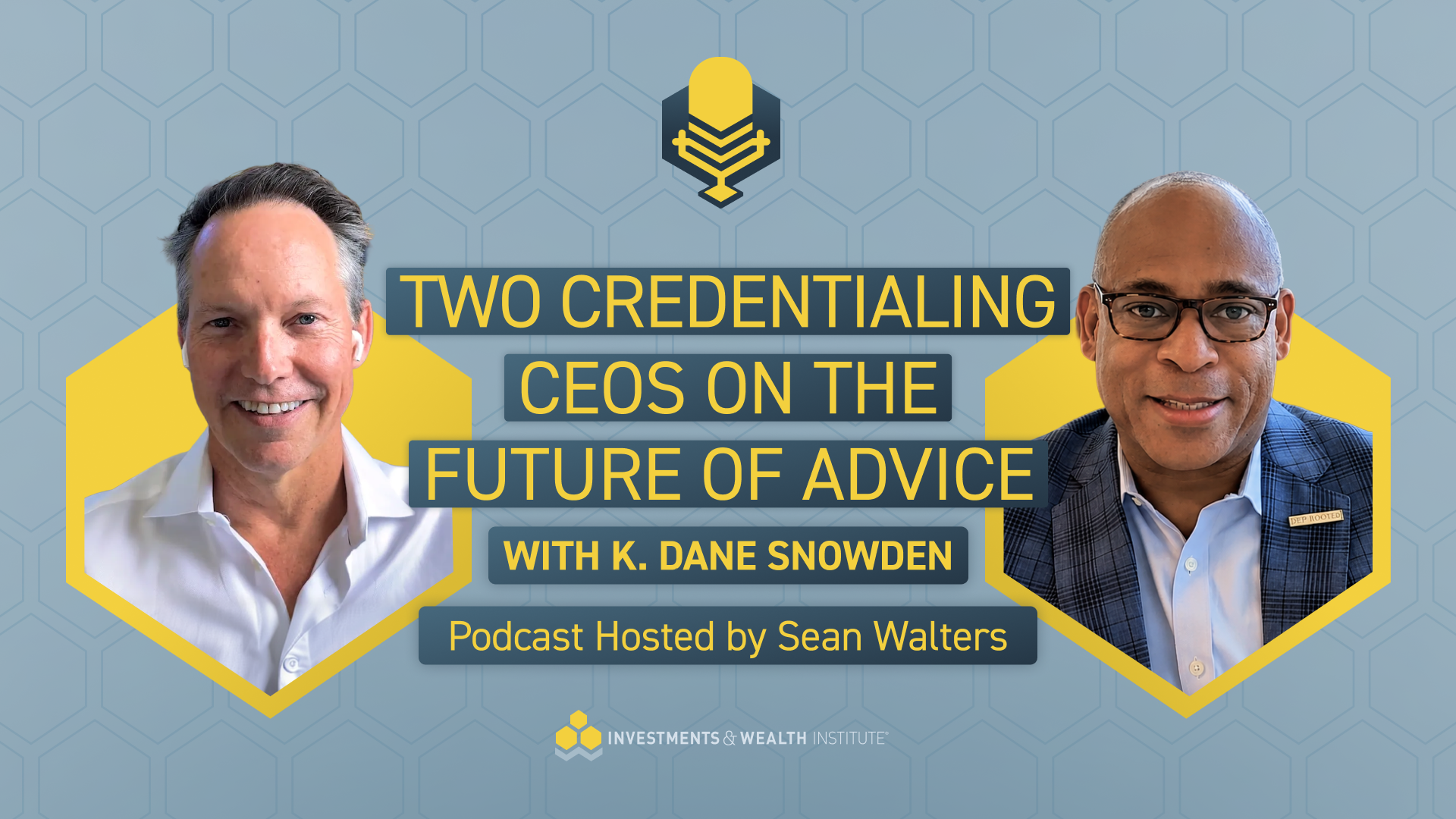 Two Credentialing CEOs on the Future of Advice July 14, 2026](https://content.investmentsandwealth.org/podcast/future-of-financial-advice-the-exceptional-advisor-podcast)
[](https://content.investmentsandwealth.org/)
#### Get Certified
- [Compare Certifications](https://investmentsandwealth.org/certifications/compare-iwi-certifications)
- [CIMA Certification](https://investmentsandwealth.org/certifications/cima-certification)
- [CPWA Certification](https://investmentsandwealth.org/certifications/cpwa-certification)
- [RMA Certification](https://investmentsandwealth.org/certifications/rma-certification)
#### About us
- [About Us](https://investmentsandwealth.org/about)
- [Board of Directors](https://investmentsandwealth.org/about/governance)
- [Leadership Team](https://investmentsandwealth.org/about/leadership-team)
- [Newsroom](https://investmentsandwealth.org/advisor-publications/newsroom)
- [Careers](https://investmentsandwealth.org/institute-careers)
- [Privacy Policy](https://investmentsandwealth.org/privacy-policy)
#### Support
- [Contact Us](https://investmentsandwealth.org/contact-us)
- [File a Complaint](https://investmentsandwealth.org/about/governance/report-or-file-a-complaint)
© Copyright 2026 by Investments & Wealth Institute
```json
{
"@context" : "https://schema.org",
"@type" : "BlogPosting",
"author" : {
"@type" : "Person",
"name" : "Sean R. Walters, CAE, Chief Executive Officer, Investments & Wealth Institute",
"url" : "https://content.investmentsandwealth.org/podcast/author/sean-r-walters-cae-chief-executive-officer-investments-wealth-institute"
},
"dateModified" : "2026-09-15T07:57:42.148Z",
"datePublished" : "2026-09-15T07:57:42.000Z",
"headline" : "How to Talk to Clients About Politics | Exceptional Advisor ",
"image" : [ "https://content.investmentsandwealth.org/hubfs/IWI-ExceptionalAdvisor-HostandGuest-1920x1080-Episode-9.png" ],
"mainEntityOfPage" : {
"@id" : "https://content.investmentsandwealth.org/podcast/how-to-talk-to-clients-about-politics-exceptional-advisor",
"@type" : "WebPage"
},
"publisher" : {
"@type" : "Organization",
"logo" : {
"@type" : "ImageObject",
"url" : "https://content.investmentsandwealth.org/hubfs/IWI%20Logos/IWI%20Logo%20Horizontal/180227_4C_LOGO_Horizontal.png"
},
"name" : "Investments & Wealth Institute"
}
}
```